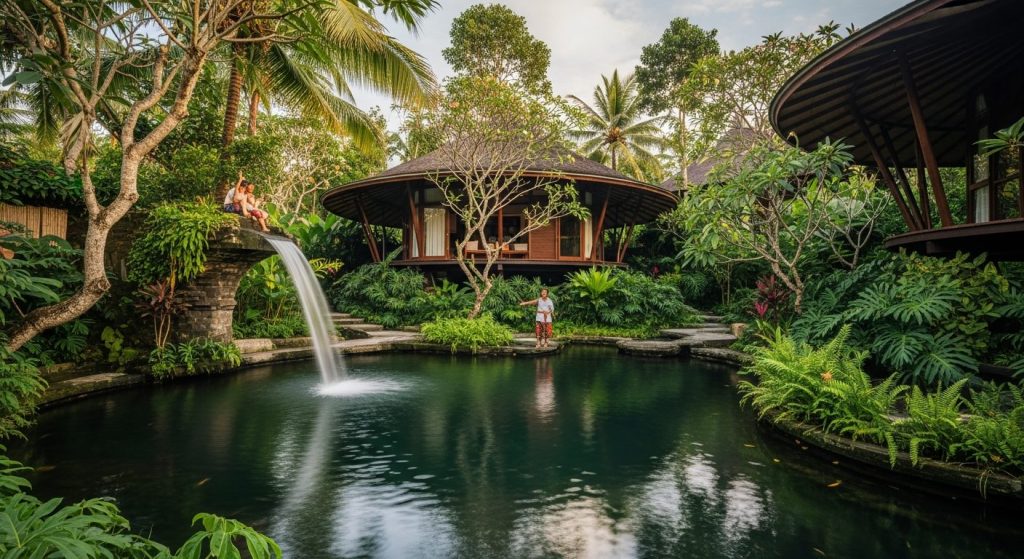
Cultural community tourism in Bali means travel experiences that are owned, run and hosted by Balinese villages themselves, where the money you spend goes directly to local families rather than to an outside operator. It is the practical alternative to a packaged “cultural show”: you stay in a village homestay, learn a craft from the artisan who makes it, walk the rice terraces with the farmer who tends them, and follow the village’s own adat (customary law) while you do it. Verda Bali is an independent eco-luxury travel editorial and concierge. We do not run these villages or guide these tours; we research and vet community-tourism operators and licensed local guides, then route your enquiry to the right one. This page is information, not licensed advice — confirm prices, schedules and conduct rules with the operator or village before you commit.
The honest version of this conversation matters because “cultural tourism” in Bali covers everything from a genuine village-owned enterprise to a coach-tour photo stop dressed up in sarongs. Tourism is roughly 68% of Bali’s economy, according to a Virtuoso editorial on the island’s hotels, which tells you two things at once: travel is the livelihood here, and the way you travel decides who actually benefits. Below is how community-based tourism works, where the well-known heritage villages sit, what to ask before you book, and how to tell an ethical experience from a staged one.
What “community-based tourism” actually means in Bali
Community-based tourism, usually shortened to CBT, is travel where the host community controls the experience and keeps most of the revenue. In Indonesia this often runs through a formal structure: village-owned enterprises called BUMDes (Badan Usaha Milik Desa), established under Indonesia’s Law No. 6 of 2014 on Villages. A BUMDes is a common framework for community-based economic activity, including tourism, so when a homestay or village tour is organised through one, there is a recognised local mechanism for the income to stay in the village. Not every good community experience uses a BUMDes — many work through cooperatives, family homestays or banjar (neighbourhood councils) — but the principle is the same: decisions and money sit with residents.
This is different from a standard day tour in three ways. First, the schedule bends to village life, not the other way around — a ceremony or a harvest takes priority over your itinerary. Second, the people you meet are participants, not paid performers reading a script. Third, the spending is distributed: your homestay fee, the workshop fee, the meals and the guide are separate transactions with different local households, instead of one ticket price absorbed by a tour company. The trade-off is honesty about comfort. A village homestay is clean and welcoming, but it is not a five-star villa; if you want eco-luxury comfort and village immersion in the same trip, the usual answer is to base in a sustainable stay and visit villages by day, which we can help structure.
What you can realistically do
- Village homestays — sleep in a family compound, eat home-cooked Balinese food, join daily routines.
- Artisan workshops — weaving, silverwork, wood-carving and batik, learned hands-on from the maker.
- Subak rice-farming — walking and working the terraced fields that run on Bali’s cooperative irrigation system.
- Heritage village visits — guided walks through traditional layouts and customary architecture.
- Temple and spiritual experiences — arranged through local hosts, observed as a respectful guest under adat conduct, not as religious instruction.
The heritage villages most travelers ask about
Three traditional villages come up constantly. Each has a distinct character, and each handles visitors differently. The table below is an orientation, not a booking sheet — exact entry arrangements, fees and what is open to outsiders change, and are set by the village, so verify before you go.
| Village | Region / character | Why travelers go | Honest note |
|---|---|---|---|
| Penglipuran | Bangli highlands; one of Bali’s most ordered traditional villages | Uniform compound architecture, swept lanes, a living example of village planning and adat custom | Popular and can be busy; go early, and treat it as a lived-in home, not a film set |
| Tenganan | Karangasem; a Bali Aga (indigenous, pre-Majapahit) village | Distinct customary law, the rare double-ikat geringsing weaving, and a strong artisan tradition | Older customs are taken seriously; ask before photographing people or ceremonies |
| Trunyan | Shore of Lake Batur, Kintamani | An unusual Bali Aga burial tradition and a dramatic caldera-lake setting | Reached by boat; agree the boatman’s price clearly in advance and use a recommended local guide |
Penglipuran and Tenganan suit travelers who want architecture, craft and a calm, respectful walk through customary life. Trunyan is for the curious who are comfortable with a more remote, transactional logistics chain and want a guide who handles the boat arrangement honestly. In all three, the difference between a meaningful visit and an awkward one is the same: a local guide who belongs to or works closely with the community, and your own willingness to follow the village’s rules.
Indigenous Bali Aga villages
Tenganan and Trunyan are Bali Aga — communities that predate the 16th-century Majapahit-era influence that shaped most of lowland Bali. Their customary law, calendars and crafts differ from the mainstream, which is exactly why an indigenous Bali cultural tour is worth doing with a knowledgeable guide rather than wandering in alone. A good guide explains what you are allowed to see, what is closed to outsiders, and why — and that boundary is part of the respect, not a barrier to complain about.
Artisan workshops: learning from the maker
The most direct way to put money into village hands is to pay an artisan for their time and teaching. Bali’s craft traditions are regional and specific: silver around Celuk, wood-carving around Mas, weaving in Tenganan and other ikat villages, and batik in several centres. A genuine workshop is small, slow and a little messy — you produce something imperfect with your own hands and the artisan keeps your fee. Be wary of the opposite: a large showroom where a brief “demonstration” funnels you toward a sales floor. That is retail with a cultural wrapper, and the maker rarely sees most of the money.
- Weaving (ikat / the rare double-ikat geringsing)
- Strongest in Tenganan; labour-intensive and historically significant, so expect to learn a small step rather than finish a textile.
- Silverwork
- A long Balinese tradition; a real session means soldering or shaping a simple piece, not just watching.
- Wood-carving
- Centred on villages with multi-generational carvers; ask whether you learn from the carver or a sales guide.
- Batik
- Wax-resist dyeing you can genuinely try; a good host explains the patterns’ meaning before you start.
If supporting craft livelihoods is the point of your trip, tell us and we will route your enquiry to operators whose workshops are run by the artisans themselves. Ready to shape a few days around real craft and village stays? plan your eco-luxury Bali trip with us, and you can send the same details by WhatsApp if that is easier than email.
Subak rice-farming and the landscape that holds the culture
Balinese culture is not separate from its rice terraces — it is partly built on them. Subak is the island’s cooperative irrigation system, where water is shared between farmers through a network governed as much by temple ritual and consensus as by engineering. A subak experience is one of the gentlest forms of community tourism: you walk the bunds, learn how water is allocated, and often share a meal with the family who farms the plot. It is low-carbon, low-impact, and the income goes straight to working farmers. For travelers who find temple tours too crowded, this is frequently the more memorable half-day.
Temple and spiritual experiences — as a guest, not a tourist
Sacred-site and spiritual experiences are among the most requested and the most misunderstood. The honest framing: these are cultural experiences arranged through local hosts and licensed guides, not religious instruction, and Verda Bali offers no spiritual or wellness outcomes — only neutral descriptions of what a host provides. A water-purification ritual, a temple visit, or a quiet retreat at a spiritually significant place can be genuinely moving, but it is the village’s faith, not a product. The single most important thing you bring is conduct.
Adat conduct rules to follow
- Wear a sarong and sash at temples; many sites provide them, but confirm with your guide.
- Never step in front of people who are praying, and keep your head lower than priests where indicated.
- Menstruating women are traditionally asked not to enter certain temples — this is adat, not a slight; respect it.
- Ask before photographing ceremonies or individuals; some moments are closed to cameras entirely.
- Follow your local guide’s instructions on where you may and may not go — boundaries are part of the custom.
If you want a quieter, retreat-style cultural stay rather than a busy temple circuit, that is a real option, but it should be described in plain terms — a calm place, a knowledgeable host, time to slow down — not promised as a cure for anything. For health or wellbeing concerns, consult a qualified professional.
How to tell ethical community tourism from a staged one
The greenwashing problem has a cultural cousin: experiences that look authentic and “give back” but route the money elsewhere. Use these checks before you book.
| Question to ask the operator | What a good answer sounds like |
|---|---|
| Who owns and runs this experience? | A named village, BUMDes, cooperative or family — not a vague “we work with the community” |
| How much of my payment stays in the village? | Specifics: homestay, guide, workshop and meals paid to local households |
| Is the guide from this village or licensed locally? | Yes, with a clear connection to the community |
| What are the conduct and photography rules? | Clear adat guidance given upfront, including what is off-limits |
| Group size and frequency? | Small groups; visits paced so they don’t overwhelm daily life |
Two red flags outweigh most marketing: large daily coach groups through a small village, and any experience that involves captive wildlife or animal performances — we steer travelers away from both. The strongest signal of an ethical operator is specificity. Vague generosity (“a portion supports local communities”) usually means very little reaches anyone.
How Verda Bali fits in — and how we earn
We are an independent editorial and concierge, not a licensed tour operator or DMC, and we do not run any village, homestay or temple ourselves. We research community-tourism operators and guides against our own editorial criteria — community ownership, fair payment, respect for adat, small-group pacing — and these are our editorial standards, not a third-party certification or a government endorsement. When you enquire, we match you to a vetted local partner and you book directly with them.
On money, plainly: no one can pay to change what we publish; if you proceed with a partner they may pay us a referral fee at no extra cost to you. That model keeps these guides free and our recommendations editorial rather than pay-to-list. Everything here is information, not licensed advice — for safety, health or any critical detail, confirm with the operator, local authorities or a qualified professional, and check your government’s current travel advice. Tell us what kind of village immersion you want and we will shape honest options around it. Plan your eco-luxury Bali trip by email or send the details over WhatsApp, and we will reply with a small, considered shortlist rather than a brochure.
Frequently asked questions
What is community-based tourism in Bali?
It is travel where a Balinese village owns and runs the experience and keeps most of the income — through homestays, artisan workshops, subak rice-farming and guided heritage visits. In Indonesia it often runs through village-owned enterprises (BUMDes), established under Law No. 6 of 2014 on Villages, so the revenue stays local rather than going to an outside operator.
Which traditional villages can I visit in Bali?
The most-visited are Penglipuran in Bangli, known for its ordered traditional architecture; Tenganan in Karangasem, an indigenous Bali Aga village famous for double-ikat geringsing weaving; and Trunyan on Lake Batur, known for an unusual burial tradition. Entry arrangements and fees are set by each village and change, so confirm current details with a local guide before you go.
How do I know my money actually reaches the village?
Ask who owns and runs the experience, how payment is split, and whether your guide is from the community. Good operators answer specifically — naming the village, BUMDes or families paid. Vague phrasing like “a portion supports local communities” usually means very little reaches anyone.
Are the temple and spiritual experiences religious instruction?
No. They are cultural experiences arranged through local hosts and licensed guides, observed as a respectful guest under adat conduct rules. Verda Bali shares information, not spiritual or wellness advice, and makes no outcome promises. For health concerns, consult a qualified professional.
Does Verda Bali charge me to plan a community-tourism trip?
Our guides and enquiry service are free to you. No one can pay to change what we publish; if you proceed with a partner they may pay us a referral fee at no extra cost to you. You book directly with the vetted local operator we introduce.