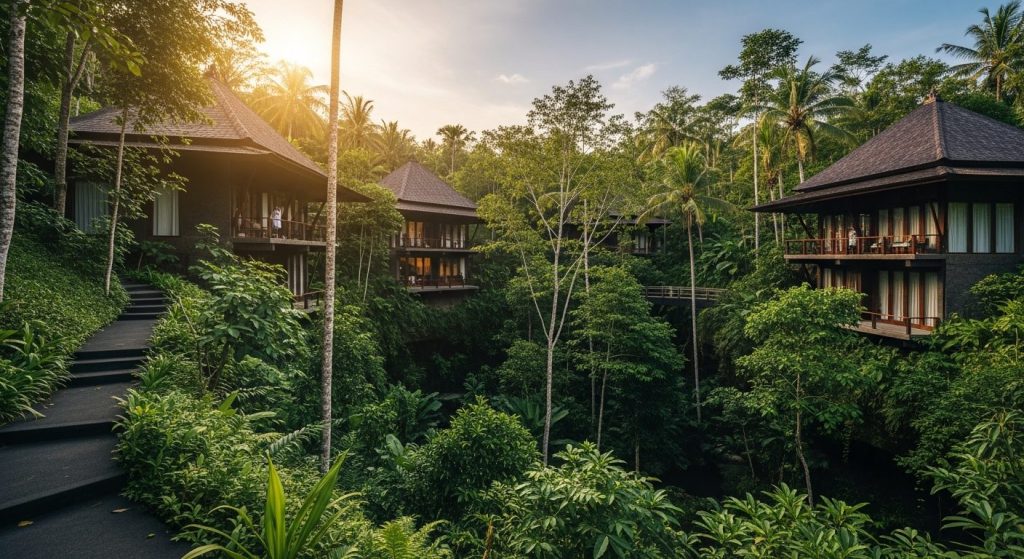
A nature jungle tour with Bali guides is a guided walk through the island’s rainforest, river gorges, rice terraces and waterfall valleys led by a licensed, local trek guide who handles route, safety and interpretation. The good ones are run by eco-certified or community-rooted guides who keep groups small, stay on established trails, and read the forest for you — naming the trees, the birds, the offerings left at a banyan root — instead of marching you to a swing for a photo. That distinction is the whole point of this page.
I’m Verda Bali Editorial Desk, the field editor here at Verda Bali. I’ve spent years walking these trails beside licensed Balinese guides and reef-restoration crews, and I’ve learned to tell a genuine conservation outing from a staged one within the first kilometre. We are an independent eco-luxury travel specialist — our own brand, not a tour operator. We don’t own trails, hold a tour-operating licence, or run the treks ourselves. What we do is research and vet local guides, then hand-match you to the right one. Everything below is travel information and curation, not licensed advice; for binding terms, fitness requirements and safety calls, the licensed guide you book is the authority.
What “nature jungle tour Bali guides” actually means
The phrase covers a wide spread, from a gentle two-hour rice-paddy walk to a pre-dawn ascent through highland cloud forest. They share three things: a natural setting, walking as the main activity, and a guide who is meant to be both your safety net and your interpreter. The middle word — guide — is where quality lives or dies.
Bali’s official tourism framework expects guides working with visitors to hold a guiding licence, and many serious nature guides also carry eco or specialist training. A licence is not a personality test, though. It tells you someone has met a baseline; it does not tell you they care about the moss they walk on. So when we vet, we look past the laminated card to how a guide behaves on the trail: do they brief group size honestly, keep you on the path, pack out litter, and talk about the place as a living system rather than a backdrop?
Slow, regenerative travel versus the day-tripper machine
Tourism is roughly 68% of Bali’s economy, according to industry sources including Virtuoso — which means a lot of nature has been turned into a queue. You’ve seen the photos: the jungle swing, the identical “secret” waterfall with forty people waiting their turn, the gate fee with no guide attached. None of that is inherently evil, but it is the opposite of what we curate. We favour guides who take fewer people to quieter trails, move at a human pace, and route money toward the village whose land you’re crossing. That’s the regenerative end of the spectrum — leave the place, and the people, a little better than you found them.
The main types of Bali jungle and nature eco-tours
Most enquiries fall into one of five buckets. Knowing which one you want makes matching you to a guide much faster.
Rainforest and ridge treks
The deeper-forest experiences — Munduk’s waterfall network in the central highlands, the Sambangan “secret garden” cascades in the north near Singaraja, and Sidemen’s river-and-ridge walks under Mount Agung in the east. Expect uneven ground, river crossings, and real elevation. A licensed guide matters most here, both for navigation and because conditions change fast after rain.
Rice-terrace and cultural walks
Gentler, often a half-day, threading through working subak rice systems around Ubud, Sidemen or Jatiluwih. These pair naturally with community-based tourism — a farmer explaining the irrigation, a stop at a family compound. Low difficulty, high reward if your guide knows the families.
Waterfall hikes
Bali has dozens of falls, and the difference between a crowded one and a quiet one is usually the guide and the hour. The best outings combine two or three lesser-known cascades on foot rather than driving you to a single Instagram stop.
Jungle-retreat day experiences
Based out of Ubud, Munduk or a mountain eco-lodge, these mix a guided walk with a slower rhythm — a swim, a meal sourced nearby, time to actually sit in the forest. Good for travellers who want nature without a sunrise alarm.
Highland and mountain eco-lodge walks
Cooler-climate trails around Bedugul, Munduk and the northern lakes, often run from eco-lodges that double as the base. Birdlife is richer up here, and group sizes tend to be smaller by necessity.
Comparing the experiences at a glance
| Tour type | Typical regions | Difficulty | Time needed | Best for |
|---|---|---|---|---|
| Rainforest / ridge trek | Munduk, Sambangan, Sidemen | Moderate to hard | Half to full day | Fit walkers, nature-first travellers |
| Rice-terrace & cultural walk | Ubud, Jatiluwih, Sidemen | Easy | 2–4 hours | Families, first-timers, slow travellers |
| Waterfall hike | Sambangan, Munduk, Gitgit area | Easy to moderate | Half day | Couples, photographers wanting quiet falls |
| Jungle-retreat day | Ubud, Munduk, mountain lodges | Easy | Full day | Rest-and-reset travellers |
| Highland eco-lodge walk | Bedugul, Munduk, north lakes | Easy to moderate | Half day | Birdwatchers, cooler-climate seekers |
Treat difficulty and timing as orientation, not gospel — trail conditions, rain and your own pace move these around. Your chosen guide will give you the real picture for the day you walk. Last verified June 2026.
How we vet a nature guide before we recommend them
We score guides on a short list of things that separate conservation from photo-op. To be clear, this is our own editorial assessment — not a certification, a licence, or any kind of compliance proof. It’s how we decide whom to introduce you to.
- Licensing and training. We ask for a current guiding licence and any eco or first-aid credentials, and we expect them to be verifiable directly with the guide before you book.
- Group size. Smaller is better for the trail and for you. Guides who cap numbers honestly score higher than those who lump strangers together to fill a van.
- Trail ethics. Staying on established paths, no feeding wildlife, packing out litter, no cutting “shortcuts” through fragile undergrowth.
- Community roots. Does the guide come from, or work with, the village whose land the trail crosses? Money staying local is part of low-impact travel, not separate from it.
- Honesty about difficulty. A guide who talks you out of a trek that’s wrong for your fitness has just earned my trust faster than one who says “easy, easy” to anyone with a wallet.
If you want to see the whole criteria framework we apply, our guide on comparing eco-tours in Bali lays out the scoring in detail, and the greenwashing explainer covers the marketing tells to ignore.
A few honest trade-offs
Quiet trails are quiet for a reason — they’re often further from your hotel, rougher underfoot, or only good at certain hours. The “secret” waterfall an hour’s drive away with a 40-minute scramble will reward you with solitude; the roadside one will not. Slower, smaller tours usually cost a little more per person than a packed minibus run, because the maths of small groups is simply different. We think that premium buys you the actual experience you came for. You may disagree, and that’s a fair conversation to have when you enquire.
Where the jungle meets the rest of your trip
A nature walk rarely travels alone. Many of our readers pair a jungle day with the experiences it naturally connects to. Birdwatchers extend into our wildlife and conservation experiences with licensed guides, including West Bali National Park and its critically endangered Bali starling. Slow-travel couples add a rice-terrace cultural walk through our community-based cultural tourism and village walks. Those who want to learn how the land actually feeds people move on to permaculture and farm tours. And if you’d rather rest deep in the canopy, our eco-wellness retreats in the Ubud rainforest put you a few steps from the trailhead.
Getting there matters too. Remote trailheads are exactly the kind of journey where a thoughtful transfer makes sense — we cover lower-emission options on the carbon-conscious private transfers page, including EV and hybrid choices where they’re genuinely available rather than just badged that way.
If you already know roughly what you want, you can plan your eco-luxury Bali trip with us and we’ll shortlist licensed guides matched to your fitness, dates and the regions you’re drawn to. A quick message on WhatsApp works just as well if you’d rather think out loud first — there’s no obligation, and we’d rather you ask three questions than book the wrong walk.
How our referral model works, plainly
Here’s the part most sites are vague about, so I’ll be blunt. Verda Bali is an independent editorial brand. We research and vet guides, then introduce you to the ones that fit. No one can pay to change what we publish; if you proceed with a partner, they may pay us a referral fee at no extra cost to you. That fee keeps these guides free to read and keeps our recommendations editorial rather than for sale. We don’t run the tours, we don’t hold the licence, and we don’t take your payment for the trek — you book and pay the licensed guide or operator directly, and their terms govern your day on the trail.
Practical notes before you walk
Footwear with grip beats fashion every time; Bali trails turn slick fast. Carry water and a light rain layer even in dry season, especially in the highlands. Tell your guide honestly about knees, asthma, age and experience — they route around your limits, not the other way. Start early for both cooler air and fewer people. And treat anything you read here, including difficulty levels and seasons, as general information to plan with; the licensed guide you book confirms the binding details for your specific tour.
Frequently asked questions
Do I really need a guide for Bali’s jungle, or can I walk alone?
For short, signposted rice-terrace strolls near towns, some travellers go unguided. For rainforest, river gorges, waterfall scrambles and any highland route, a licensed local guide is strongly advisable — trails are often unmarked, conditions shift after rain, and a guide carries the local knowledge and safety judgement that keep a walk from becoming a rescue. This is general guidance; assess your own fitness and confirm specifics with the guide.
How much does a guided nature or jungle tour in Bali cost?
Prices vary widely by region, group size, duration and inclusions, and we publish only indicative ranges rather than live quotes. Smaller, slower, more remote tours typically cost more per person than packed group runs. We’ll share current partner-confirmed pricing when we match you, since rates change and your itinerary shapes the figure. Last verified June 2026.
What makes a guide “eco-certified,” and does it guarantee a good experience?
“Eco-certified” can mean anything from a recognised training programme to a self-applied label, so we don’t treat the phrase as proof on its own. We weigh a current guiding licence alongside on-trail behaviour — group size, trail ethics, community ties. A badge is a starting point, not a guarantee; we verify the guide’s actual practice before recommending them.
Are Bali jungle tours suitable for families with children?
Many are — gentle rice-terrace and waterfall walks suit families well, while steep ridge treks generally don’t. The honest answer depends on the children’s ages, the trail and the guide’s pace. Tell us who’s coming when you enquire and we’ll match you to a route and guide used to walking with families.
How does Verda Bali actually choose which guides to recommend?
We assess guides against our own editorial criteria — licensing, small group sizes, trail ethics and community roots — and introduce you only to those that meet them. This is editorial vetting, not a third-party certification. No one can pay to change what we publish; if you proceed with a partner they may pay us a referral fee at no extra cost to you, and you book the licensed guide directly.
When you’re ready, plan your eco-luxury Bali trip and tell us the kind of forest day you’re picturing. We’ll do the matching, and you’ll walk with someone who knows the trail — and respects it.
Verda Bali Editorial Desk is the Nature, Marine & Wildlife Field Editor at Verda Bali. He covers Bali’s jungle treks, marine eco-tours, dive and snorkel sites, bird-watching and conservation experiences, pressure-testing operators for genuine low-impact and ethical-wildlife practice. This article is travel information, not licensed advice.